

Morphodynamics
A Theory of Consciousness

“The universe is not only stranger than we imagine; it is stranger than we can imagine.”
— J.B.S. Haldane
A theatre performer was once asked to explain the orbital mechanics of Mercury using only his facial expressions. It was a spectacular show, but he failed—not for want of trying, but because facial expressions simply aren’t the right medium for conveying spacetime curvature, gravitational equations, or relativistic corrections.
How odd it is that, after millennia of philosophical effort, we have made so little progress in solving the enigma of consciousness. It’s complex, we declare with a semblance of gravitas, before resuming our aimless circling. Yet the reason may be that, like the hapless performer, we are using the wrong language. Our natural, formal, and even mystical languages, though insightful in their own domains, seem utterly inadequate for describing the subjective and the objective within a single framework. And we need to do this because without a language capable of bridging the subjective and the objective, we cannot truly understand either in isolation, since each is always already entangled with the other in the very act of being conscious of anything at all. However, we don’t even have a language for each of them. Every language we possess—mathematical, natural, symbolic, or embodied—has evolved or been devised to chart the objective world. Trying to press these languages into service to explain consciousness is like attempting to measure the softness of a pillow with a thermometer. The tool simply isn’t designed for that purpose. At best, such languages can evoke the subjective, but they cannot formally describe it from within.
The Morphodynamic Theory of Consciousness holds that consciousness emerges from the dynamic organisation of fundamental, information-like elements. The evolving forms and patterns—the morphodynamics—are generated by an underlying generative language.
In this essay, I shall examine several key questions that arise from this theory. These include: what exactly constitutes these fundamental information-like elements; how their interactions produce emergent morphodynamic patterns; in what sense a generative language underlies this process; and how such a framework might allow us to address the intractable questions surrounding the nature of conscious awareness and intelligence, as well as the evolution of the mind and its interface with matter. Indeed, the theory suggests a resolution to the enduring mind–body problem by revealing the generative language and its fundamental elements as the unifying process that spans both mental and physical domains. Finally, I shall consider its broader philosophical implications for our understanding of the world and our place within it, particularly regarding the reformulation of entrenched dualities such as mind and matter, subject and object, and inner experience and external reality.
It is not really surprising that consciousness itself has offered us the key to uncovering this generative language. It is, after all, the primary it-ness of our existence—the most immediate and self-evident phenomenon we can encounter. It is the ground of all experience and knowledge, without which no inquiry or observation would be possible. In this most basic sense, it is almost inevitable that consciousness would eventually reveal the generative language that underlies its own emergence.
The big question, however, is why it has taken us so long to recognise and formalise it.
You can’t know what you can’t describe
The need for a new language
Different systems of language impose distinct frameworks of understanding. They shape the way we interpret problems, the assumptions we make, and the boundaries of what is thinkable. It is like sitting inside a box with holes punched through the sides. Each hole offers a unique perspective, but you cannot discover anything about the roof by looking through the hole near your foot. The wrong language will forever keep us circling the periphery of the solution we hope to find. In the case of consciousness, this has been our situation for centuries.
What we need is a new kind of formal language—one capable of describing both the objective and the subjective, not merely in metaphorical terms but in a constructive, explanatory way. It must reveal how mind, especially consciousness, and matter arise as different yet related forms of organisation from the most fundamental level of reality. Only such a language can demonstrate how consciousness is part of the universe, rather than standing apart as some ethereal anomaly.
Yet here we face a paradox. Scientific revolutions require a shift in the entire paradigm through which we apprehend the world. Crucially, such a shift cannot be fully articulated using the vocabulary and assumptions of the old paradigm. It’s like an ice cube trying to understand what it’s like to be a liquid. To do so, it must first become a liquid, but until it does, it cannot comprehend the nature of liquidity from within the fixed and frozen logic of its own condition. However, the very act of melting requires it to grasp something of liquidity in advance—something it cannot yet know as an ice cube.
In this case, the language we need must already transcend the conceptual constraints that keep us in ignorance. Without it, we cannot even formulate the problem properly, let alone resolve it. We find ourselves in a bind: compelled to develop a new paradigm from within the very one that renders the task impossible.
Developing such a language may seem as daunting as solving the mystery of consciousness itself. In a very real sense, it is the same problem. And yet we have no choice but to attempt it. The stakes are unnervingly high. If we fail to make this transition, our progress will slow to a dispirited crawl. We will drag ourselves across an increasingly desolate intellectual landscape until the fevered heat of frustration bakes us into dust. The old paradigm has given us only half a world, half an understanding, and half an identity. One foot planted in the empirical, the other still mired in the discredited realm of the mystical. That “woo-woo” half contributes virtually nothing to scientific or technological progress—yet we cannot quite pull our foot free of the sticky mud.
How much are we missing in physics and technology because we have failed to account for half of reality? How much worse will mental health and social fragmentation become if psychology continues to rely solely on behavioural inference, while the main star of the play—consciousness itself—remains unmeasured and formally inaccessible? And at what point will our dazzling progress in AI grind to a halt because of economic, energy and computational constraints, simply because we still have no idea how to make machines think, feel, or understand as we do?
If we continue building our brick tower without mortar, it will inevitably collapse.
Something has to be authoring reality
The language of creation
The good news is that we do have a way to resolve our Kuhnian paradox. The descriptive language we need to illuminate the mysteries of consciousness is already available to us. Indeed, it is the most familiar of all: the foundational mode of expression from which every other language—natural, formal, and symbolic—ultimately emerges.
This proto-language, embedded in the architecture of sentient life and expressed in the functioning of any organism with a central nervous system, has simply never been formalised. Yet it is there, active and shaping the very fabric of cognition well before any of it is passed on to the mind’s conscious awareness. The challenge, then, is not to invent a new language but to recognise the one that familiarity has rendered invisible—and to give it formal structure.
The artist uses this pre-verbal proto-language. It is underpinned by the sense of things: the sense of form, flow, proportion, and presence. Creativity for the artist is the art of sensing how forms relate in space; of feeling rhythm, pacing, tension, and release; of grasping wholes and patterns before any conceptual articulation; of a rightness that is sensed long before it is reasoned.
For the artist, it is not a formal language. It is a felt grammar of being. You do not learn it by definition—as I have experienced first-hand—but know it by doing, by noticing, by waiting for it to reveal itself. It is a pre-conceptual feel for how things hold together, move, and carry meaning—beneath both words and numbers.
We have long regarded this “sense of things” as either discrete feelings—an aha moment or a gut intuition that erupts like a lightning bolt—or as a continuous undercurrent that quietly guides our reasoning. As such, we have categorised it as a feeling to be filed in the same cabinet as bodily feelings and emotional experiences. This is a significant mistake, because the question we never asked was: what if our experience of “the sense of things” is, in fact, the echo of a far more sophisticated language—the language of cognition itself? That, as it turned out, was the right question to ask.
This idea is hardly far-fetched when we consider that the mind—or more precisely, consciousness—possesses a surprisingly rich and multifaceted array of “senses,” or internal dimensions of awareness. These are not merely sensory in the ordinary, perceptual sense, but forms of mental orientation and subjective attunement to various aspects of reality, both within and without. We have a sense of distance, direction, location, magnitude, belonging, scale, curvature, time, change, and much more besides—in fact, our entire experience of reality is the sense of something.
The question is whether these senses of things can be broken down into more fundamental elements—and, if so, whether we might then uncover a formal language capable of finally explaining the phenomenon of consciousness itself.
At the very bottom, there will be something strange
The strangely familiar
Let’s turn to the physical, for a moment. We must accept that, at the most fundamental level, physical reality cannot rest on nothingness; it must consist of something whose very existence is secured by its determinate nature. To be at all is to be some particular kind of thing. Every existent is inseparable from—and defined by—what it is.
Yet this nature is not the familiar manifold of spacetime, matter, or forces. Contemporary fundamental physics acknowledges as much, proposing that the substrate underlying matter and forces might take the form of quantum fields, strings, spin networks, or some as-yet-unknown entity. Nevertheless, for methodological reasons, physicists must bracket this uncomfortable somethingness: such claims are neither falsifiable nor testable within the current empirical framework.
Still, whatever its form, the most fundamental stratum of reality can be characterised as non-physical, from which the physical emerges, and whose own nature remains tantalisingly opaque.
That means, whether in physics or consciousness, any existent must be determinate and defined by what it is, and that some, potentially shared substrate, grounds both the physical and experiential domains. If this is so, then at some point our inquiry into consciousness will be compelled to cross a threshold: from the familiar (how we experience consciousness, and by extension the world) to the somewhat strange.
This strangeness is compounded by the fact that consciousness presents itself as a flow of structurally complete thoughts and experiences. Whether these arrive coherent, fragmentary, or ambiguous is secondary to the more arresting fact that they come already assembled, composed of elements and patterns that remain invisible within experience itself.
It is therefore likely that consciousness emerges from more fundamental constituents whose nature, structure, or interactions are not immediately evident from the vantage point of our awareness. It is much like how fields are not apparent when observing particles, or how code is hidden when looking at a character in a game. These elements may, at first glance, appear strange or even alien relative to what consciousness feels like.
If these fundamental constituents are information-like, as the Morphodynamic Theory proposes, then what, precisely, is information? We possess theories describing how information behaves—how it can be measured, transformed, or propagated—but not what it is in any ontologically definitive sense. And yet, since our very capacity for awareness relies upon the elements that compose it, they must, in some way, be accessible or intelligible to us. Otherwise, we would have no grounds whatsoever for relating them to experience.
We should therefore expect the generative substrate of consciousness—the foundational elements and the syntax of whatever new descriptive language we devise or uncover—to appear at once eerily familiar and utterly strange. I will show that this is the case.
What if language creates more than just mental pictures?
Morphodynamic Theory
To recap: The Morphodynamic Theory proposes a new generative language from which mind and matter emerge. If confirmed, it would mark the first step in lifting the constraints on understanding imposed by our established languages. It claims that the most fundamental layer is information-like, whose nature resembles the sense-ness we experience at the emergent level of consciousness. It then identifies the elements involved and shows that they function as a formal language with a distinctive lexicon, syntax, and grammar.
I will show that:
· There is a deeper, common layer beneath mind and matter. This is the underlying unity that a philosophy called Neutral Monism has long sought as the true basis of both mental and physical phenomena.
· This layer has identifiable basic forms—fundamental elements.
· These elements behave according to a formal structure—a kind of proto-grammar or syntax—that gives rise to all known phenomena.
· This structure constitutes a generative language of reality.
In this theory, the most fundamental stratum of reality can be characterised as non-physical information (no surprise there), whose nature is revealed by what it expresses at higher levels in the hierarchy of emergence. In other words, the nature of these elements bubbles up into conscious awareness. And what bubbles up—in fact, the only things that bubble up—are the senses of things: the sense of somethingness, the sense of distance, direction, movement, time, space, relationship, rhythm, colour, touch, sound, smell, taste, feelings, and so on.
So, the nature of information is sense-ness. There is nothing deeper. It is tempting to ask what constitutes the blue-ness of blue. Regrettably, the answer must be that it is not composed of anything else. Blue is the tag we assign to a fundamental informational element whose nature is blue-ness. It simply is what it is. Blue-ness is just blue-ness. Anything deeper, if it exists at all, lies beyond our reality. I call these fundamental elements Sensicles.
So if you insist that everything must be made of something else, spiralling down in an infinite regress, you will have to look outside our reality for your answer. Good luck with that. However, if this still feels somewhat unsatisfactory (it does to me), Morphodynamic Theory at least pushes our conceptual understanding a step closer to an intuitively satisfying one. It takes us right up to the edge of our reality—and then hints at what lies beyond.
The stuff of minds - Sensicles
To make any sense of the nature of Sensicles, you must be attuned to the pre-verbal language in which your mind primarily operates. Put differently, you must learn to think in that proto-language if you wish to grasp it at all. This often requires effort. Our rational mind relies heavily on natural language, which tends to obscure the Sensicle language by operating at a higher plane of emergence. It is like trying to see fine details painted on a canvas through a layer of frosted glass—our natural language blurs direct perception of the proto-language from which it emerges. Yet that is precisely what is required: without this attunement, it becomes far more difficult to appreciate the true nature of the elements, syntax, and grammar that compose this language.
Sensicles are as fundamental as anything can be imagined. Each is its singular property: it is nothing but its own nature. For example, blue-ness embodies only the essence of blue-ness. It has no other features or properties—not even the property of mixing with another colour or spreading over a surface to become visible to the mind. It is just blue-ness. That is the essence of being fundamental: a single property defined entirely by its singular nature. Whenever one encounters a Sensicle, recognition itself is already the first step of emergence, not an additional property layered upon the Sensicle.
Some readers might wonder why I do not simply refer to these Sensicles as qualia. Qualia refer to the raw felt qualities of sensations, emotions, thoughts, or anything else. Although Sensicles may appear equivalent to qualia, I avoid that term, as it is too entangled with subjective consciousness to serve as an objective, foundational element in an account of how things fundamentally come into being, including consciousness itself. Qualia are what we experience in consciousness after it has been assembled by Sensicles.
The question naturally arises: if a Sensicle possesses only its singular nature—so that something like blue-ness lacks even the property of spreadability—how is it possible for us to see it extended across a surface or mixed with another colour? The answer lies in the first Sensicle we will examine.
[ ]
The Set (or Set-ness) Sensicle is the sense of something-ness.
Imagine standing alone in a dark forest. You think you have heard a twig snap. You feel that there is something there, though you do not know what. That feeling of something-ness is as close as we can get to experiencing the Set Sensicle.
In such moments, your mind instinctively tries to fill that set with a further set that will define the cause of the noise. For us, as conscious agents, everything is a “something.” Indeed, there is not a single thing in this universe—whether physical or mental—that is not a “something,” and that something-ness is made possible by the nature of the Set Sensicle.
It allows collections of Sensicles to cohere into a unified presence without altering or blending their individual natures. For example, if we place a red and yellow Sensicle in a Set, they don’t mix together. The orange we experience is what emerges from the Set Sensicle. Without the Set Sensicle, other Sensicles remain uninstantiated in our reality: they are a no-thing. In this sense, if you have ever wondered whether the universe emerged from nothing, it did—though only in the sense that these elements are real in potential but have not yet become anything from the perspective of our universe or awareness. Without the Set Sensicle, these fragments remain in a “not-of-our-reality” state: they do not register as part of our world. They have no thing-ness, no presence, no felt “there is something.”
A straightforward way to visualise this process in action is to imagine a green clown. Before the act of imagining, your blue clown did not exist. Its component parts—for instance, the quality of blue-ness—did exist. Your mind gathered all the requisite elements and assembled them into a Set Sensicle. In this act of putting it all together, the blue clown emerged.
Conversely, without elements for the Set Sensicle to instantiate, the Set Sensicle itself is meaningless. Simply entertaining the concept of the Set Sensicle already instantiates it in thought—a reflexive “double nesting” [ [ ] ] that brings the very idea into being. We have no conception of what reality is like beneath the emergence of our universe, but as mentioned earlier, there is a hint in what bubbles up into our awareness.
The Set Sensicle is the singular entity whose nature enables structure and emergence to arise from arrangement alone. It constrains elements into sets, allows them to form relationships, and introduces the persistence of identity. From these sets, novelty arises through the relational interactions of the elements they contain.
Unlike a mathematical set, which is defined by explicit membership rules, the Set Sensicle—by its very nature and in combination with other Sensicles—brings forth the rules underpinning pattern formation. We begin with a collection of elements that are, in themselves, utterly meaningless no-things. The Set Sensicle coheres them into various sets, giving rise to first-order emergence. Those sets then cohere into higher-level sets, resulting in second-order emergence, and so on. It’s like atoms forming molecules, molecules forming macromolecules, those forming cells and all the way up to us.
The Set Sensicle does not merely organise patterns—it is what makes the very notion of pattern and structure possible. Without it, there is no coherence, no form, no rule—only undifferentiated potential. With it, “something” emerges from nothing (as in not-a-thing) through the instantiation of presence.
It is like having dozens of actors representing various characters in a stage production. These characters do not exist until the actors step onto the stage, at which point the characters come to life. The stage acts like a Set, bringing everything together as ‘a-thing’—a show.
◿
The next Sensicle we will examine is the Magnitude (or Magnitude-ness) Sensicle.
Taken in isolation, this Sensicle is again entirely incomprehensible to our conscious awareness. In such a solitary state, what exists is not magnitude as we ordinarily feel it, but only the potential for magnitude—a kind of undifferentiated sense intensity. This is a qualitative presence that has not yet been placed within any relational frame. It is neither “large” nor “small,” for there is no scale and no contrast. It simply is: a raw, non-relative intensity of presence. Don’t worry about not ‘getting’ it on an intuitive level. You can’t.
In its emergent form (when it’s ‘in’ a Set Sencile with other elements and where our understanding kicks in), the Magnitude Sensicle contributes the sense of relation—the intuition of “more-ness” or “less-ness,” a pre-linguistic, pre-mathematical awareness of quantity or intensity within Set structures. The Magnitude Sensicle exerts a profound influence on reality and our conscious experience of it. While the Set Sensicle creates structure, Magnitude introduces variability and the potential for change. It is crucial to the emergence of space, time, movement, and the very basis of causation. If the Set Sensicle is the creator, Magnitude is its power.
Another distinctive quality that Magnitude contributes to emergent phenomena is its additive nature. A hundred instantiated Magnitude-ness sets create a sense of “more-ness” in relation to, let us say, ten references. It is the Magnitude Sensicle that enables the Set Sensicle to form multiple references of a set [ [◿] [◿] [◿] ]. How did it all start? The simplest way to understand this is that the sense of more-than-nothing opens the possibility of more-than-that-more. So, a unit of Magnitude in a Set with no Magnitude gave us the sense of one more than zero, and that sense of more-ness gave us one more than one and so on. Remember, Sensicles make sense in the vocabulary of their nature—sense-ness. Our natural languages are not suited for it. They are the wrong language to use, and that’s why we’ve made no progress.
To make the notation of Magnitude more straightforward, we write it as [ ◿3 ], acknowledging that each Magnitude Sensicle reference is “wrapped” in its own Set and then brought together in a parent Set.
In summary, Magnitude is the sense of a primitive relation or felt distinction: this is greater than, smaller than, or equal to that. It makes comparison possible without requiring counting or measurement. Like all Sensicles, Magnitude must be instantiated to become “a thing” [◿]. Then, for it to have value in reality—and by extension to our minds—it must cohere with some other thing in that Set [ ◇◿ ]. In other words, the Magnitude of something. Next, it requires variability through its additive nature [ ◇◿3 ]. Finally, it requires a structure to make it relational [ [ ◇◿3 ] [ ◇◿6 ] ].
I have, of course, just introduced another Sensicle, so let me present it now.
◇
The Position (or Position-ness) Sensicle represents the sense of something being somewhere. Yet in its isolated state, it is, like all Sensicles, entirely unknowable. On its own, locality loses all definitional content. There is no “where,” because there is no elsewhere. It is presence without spatial relation: a pure hereness that has no contrast, no boundary, no direction, no extent. Space, in any meaningful form, does not yet exist. The solitary element does not occupy or define a real position—it is position-ness, or perhaps more precisely, presence without placement.
The only reason the Sensicles make any sense at all is that your mind always experiences them at higher levels of emergence. You cannot think of Magnitude-ness without thinking of the magnitude of something, nor of Position-ness without thinking of something somewhere, even if you do not know where. For example, you cannot envision this element as existing in a universe that contains only a single Position Sensicle, because your mind will inevitably imagine it within an entirely black space (spatial dimensions plus colour added). Try removing the space and the colour. Even if you manage that, you will still sense the Position Sensicle in a relational context to your own position.
What I am trying to do here is create an understanding of how the Sensicles cohere to create the emergent sense experience that we are so familiar with in our conscious awareness. So, let us imagine we bring a Position Sensicle together with a selection of Magnitude sets [◇◿100]. This creates the emergent sense of position-ness combined with 100 magnitude-ness—a Position of 100 Magnitudes. At this low level of emergence, it does not make much practical sense to the mind, which is primarily concerned with relational entities. If we then place it together with another set containing a different magnitude reference amount, an emergent sense we know as distance—in its most basic form—arises: one Position/Magnitude relative to another.
[ [◇◿1] [◇◿100] ]
Of course, in consciousness, we usually experience such Sets within higher levels of emergence, where we also know what the Position refers to—the Position of what?
[ [ [object1] [◇◿1] ] [ [object2] [◇◿100] ] ]
These structures quickly become increasingly complex. A sense of distance, for example, typically comes with at least two spatial dimensions, built-in orientations, and all of this unfolds across time. Still, these lower-level Sets are experienced as brief moments of the sense they represent, which quickly blend into the larger context of emergence.
The artist, in a sense, learns to isolate these more basic Sets and focus on them during the creative process. For example, they might isolate the Set of a curve’s tension, the weight of a shadow, or the distance between two forms—not merely as visual data, but as momentary intensities of presence and relation. It is like a dancer sensing the tension in a pause, rather than experiencing it as merely a mechanical duration between two steps. These can be shaped, emphasised, or distorted so that they resonate with the larger set of felt relations, thereby creating a unified quality that guides the creative process.
There are many other equally fascinating Sensicles—such as Spin-ness and Then-ness—alongside the more familiar colours and those that combine to give rise to our emotions and our experiences of sound, smell, touch, and taste. By delving into the language of Sensicles—by coming to terms with the grammar of reality itself—we can begin to uncover insights into questions such as why we experience only three spatial dimensions, how we perceive the passage of time, what the self truly is, the nature of free will, and much more besides.
Why? Because these phenomena emerge from the language of Sensicles, understanding its syntax and grammar allows us to gain insight into their structure and function. Together, they form the foundation of our conscious experience of the world.
The knitting machine of the mind
Consciousness
Consciousness is a high-level emergent phenomenon. The Sensicles and all the various Sensicle Sets—such as those that generate a sense of distance, locality, or time—are not themselves conscious. They are not experiences, because that requires the flow of time. A single movie frame cannot give you the experience of movement. The Senciles are static senses-ness.
This is in no way equivalent to how we encounter them within consciousness. We should be careful not to conflate the sense of something with the phenomenon of consciousness itself. The sense of something is simply the nature of information; it bubbles up into the emergent event of conscious awareness. Consciousness arises only when these building blocks cohere with those that generate time and memory.
In the context of consciousness, we can divide the mind into two broad categories: the primary mind, which undertakes the bulk of cognitive processing, and the conscious-awareness function, which is a specific process that the primary mind employs to enhance its ability to create positive outcomes.
The primary mind organises the Sensicle Sets into networked structures that enable it to process information in real time, learn patterns, and generate adaptive responses. This happens in all creatures with a central nervous system, to varying degrees depending on the complexity of that system. We know it is an extraordinarily effective process: it allows jumping spiders to track their prey’s position even after losing sight of it, and enables a wildebeest calf to stand within minutes of birth.
So, what does the conscious-awareness function do? It adds the capacity to weave sections of the networked data into contextual threads of meaning that can be further networked by the primary mind into abstract structures and recalled later. It is a higher-order process that binds sense impressions and experiences into cohesive, enduring conceptual threads.
Imagine a dense network of interconnected dots, with a highlighter tracing pathways, and then imagine linking those highlighted pathways together. These threads are not fleeting sensations or automatic reactions; they are stable, relational constructs that can be recalled, examined, and applied in new contexts.
Put more simply, the purpose of consciousness is to take the raw, networked data and knit it into a tapestry of meaning that remains accessible across time. This enables the mind not merely to react to the present but to reason about the past and imagine the future. Through this integration, the mind can form abstract concepts, deliberate, and plan—capabilities far beyond what instinctual, unreflective cognition can achieve. This is how consciousness empowers us to reason, reflect, and ultimately transcend the here and now in our thinking.
The bridge between worlds
Neutral Monism solved
What happens if you stumble upon a solution to a problem—let us assume it is the right solution—but there remains one elusive piece you cannot yet figure out to make it fully work? The trouble is, you will not know it is the right solution until you have resolved that last fragment of the puzzle. If, at some point, you lose heart and veer off into other tangents, you are likely to encounter the same kind of seemingly unsolvable problems again. The bad news is that this time you will have no chance of success—none, zilch.
Neutral Monism is the idea that the fundamental substance of reality is neither purely mental nor purely physical, but a neutral “stuff” that underlies both. In other words, mind and matter are composed of these same basic, neutral elements, which can manifest as either mental experiences or physical phenomena, depending on the context. The one elusive piece that no one could figure out to make it fully work was what exactly this neutral stuff was.
Rather than working through that missing part, Materialists chose instead to declare that everything—including mind—is merely physical processes in the brain. Yet they then struggle to explain why subjective experience exists at all, rather than simply complex behaviour. It is that unsolvable problem again. Panpsychists suggest that consciousness is a fundamental feature of all matter, thereby attributing consciousness to everything, without clarifying how tiny proto-experiences can combine into full awareness. Still others, namely Idealists, insisted that reality itself is fundamentally mental or experiential, and that what we call the physical world is only a projection or construct of consciousness. However, this view risks dissolving the objective world into mere appearances, without offering a clear account of shared experience. Of course, all these positions provide solutions, but they tend to be either metaphysically heavy-handed or insufficiently precise.
Neutral Monism, in my view, is a more elegant and balanced solution because it avoids the extremes, offering a unifying description of reality that can, at least in principle, account for both consciousness and the physical world. But what about the elusive piece we need to make it work?
The Morphodynamic Theory of Consciousness, with its Sensicle-based formal language, provides a clear account of what these neutral elements are in themselves—information elements whose nature is the sense-ness of things: Sensicles. As I’ve shown, it demonstrates precisely how subjective experience emerges from arrangements of these neutral elements. It also illustrates how stable objects and causal interactions arise from neutral events, without collapsing into dualism or incoherence.
So, how exactly do Sensicles bring the physical into this picture, as required by Neutral Monism? If the most fundamental layers of reality are informational—in other words, if what underlies fields, quantum loops, or whatever substrate gives rise to particles and forces is ultimately informational—then there is no reason it should not be the same kind of information that gives rise to conscious experience. This unifying account aligns with Occam’s Razor, as it posits a single set of neutral informational elements rather than multiple entities to explain mind and matter separately.
It is the same informational elements, configured differently, employing the same lexical units, syntax, and generative grammar. It is the same underlying language that brings both mind and matter into existence. So, for example, the senses of locality, magnitude, motion, time, and so on that the mind utilises and experiences in consciousness are the very same Set constructs a particle incorporates. At the lower levels of emergence, those constructs, for the particle or force, are still informational. One set of neutral elements from which both mind and matter emerge.
The end of duality as we know it
The Mind-Body problem solved
With Neutral Monism finally resolved, we can now begin to explore how the mind evolved and how it interfaces with matter.
We surmise that somehow, attached to the neurons in our brain, there exists a seemingly non-material layer we call the mind. In the context of Neutral Monism, describing it as non-material simply means that the fundamental building blocks from which everything is made are configured in a way that is neither a particle nor a force. Since both the neurons and these non-material elements are composed of the same basic components, it becomes easier to see how they might interface—they share a common syntax. It is like constructing two different objects out of Lego bricks and then joining them together: the possibility of connection arises precisely because both forms emerge from the same underlying medium—Lego bricks.
Before asking how it all works, we should first consider why the mind exists at all. Why would evolution favour these additional, non-material attachments to neurons?
The first thing to realise is that the laws governing any configuration of building blocks are determined by the intrinsic natures of those elements and the way they are arranged. In other words, phenomena emerge, and so too do the laws that govern them. For example, the laws governing the behaviour of a tree do not reside in the cells of that tree. By their very nature, the non-material configurations will not be subject to the same laws that apply to physics. They might not be constrained by spacetime locality, conservation laws, the thermodynamic arrow, or any such familiar phenomena if they are not configured in a way that permits those phenomena to arise. Instead, they are bound by the laws corresponding to their configuration.
To illustrate, imagine building two neurons out of blue Lego bricks and attaching a yellow brick—representing the non-material construct—to each neuron. Those two yellow bricks could potentially interact regardless of how far apart you place the neurons themselves. You might object: Aren’t the two yellow bricks constrained by the neurons’ locations? After all, they are attached. The answer is no, they are not. The neurons’ spatial locality applies only at higher levels of the emergence stack. At lower levels, the constituent parts of neurons are also non-local; remember, the components are informational—they have not yet become particles. Moreover, what we call a connection is not some tangible link but rather a Set Sensicle. In other words, it is an informational connection.
Since the neurons and their non-material attachments can interact—because they share the same syntax—the clear advantage to the brain is that this informational layer can create connections between neurons that are not physically linked. This is possible because a neural spike does not traverse the neuron like a train moving along a track. Instead, it resembles a row of lights switching on and off in sequence: nothing actually travels from one end to the other; what propagates is the pattern itself. Therefore, all the non-material connection needs to do, since nothing physical is passed on, is pick up this pattern and relay it onwards. This vastly expands the brain’s functional connectivity, enabling swifter and more flexible integration of spike flows without incurring the spatial or metabolic costs of growing additional synapses. It is, in this sense, a significant evolutionary advantage for nervous systems to generate minds.
Unfortunately, there is currently no clear experimental evidence to support the occurrence of such events. This challenge is often referred to as the interaction problem of dualism. If these interactions were taking place, we would expect to see violations of energy conservation or causeless causes—such as neurons firing without any physical trigger—but we do not. However, rather than imagining a crude scenario where the mind pokes a neuron in some substantive way, it is more plausible to think of the mind’s influence as a subtle modulation rather than a direct trigger. The mind’s primary impact on the brain may be to select among available possibilities, modulate patterns of activity, sustain certain dynamics, or inhibit others.
If this is the case, our instruments may simply be too coarse to detect such extremely localised deviations. These micro-deviations might be effectively buried within what appears to us as noise and would need to be carefully isolated to be observed.
Another question to consider is how neurons construct these non-material modules. We already know that the dendrites of pyramidal neurons have many branches, each capable of accumulating voltage and generating its own spike, effectively functioning as miniature versions of the axon hillock. This is eloquently described in Mark Humphries’ brilliant book, The Spike: An Epic Journey Through the Brain in 2.1 Seconds. So, imagine that these branches also host genetically encoded Sensicles—for example, Position ◇, Magnitude ◿, and Set [ ] Sensicles.
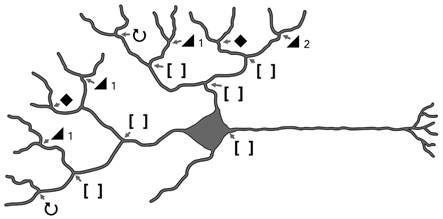
Each branch, able to send its own spike further along the dendritic tree, acts as a representation of the Sensicle interfaced at an information level of emergence. In this arrangement, when a neuron’s axon—situated at the base of all the branches—fires, it effectively confirms the presence of the upstream Sensicles. Although the axon itself does not directly receive Sensicle information from the dendrites, it only fires if a sufficient number of those upstream Sensicles have been verified by the dendrites’ activity. Therefore, when the axon does fire, that neuron stands as a representation of the entire Sensicle module. In the illustration above, this would be:
[ [ [ ↻◿1 ] [◇◿1 ] ] [ [ ↻◿1 ] [◇◿2 ] ] ]
This is how matter constructs the mind: through genetically encoded Sensicle references embedded in precise locations on the neuron’s architecture. The Sensicle modules, configured within the intricate branching of dendrites, constitute the first layer of cognition—our instincts. These instinctual patterns are pre-encoded templates: the inherited scaffold of orientation, reaction, and primitive sense-making upon which all further cognitive elaboration is built. They form a kind of primordial vocabulary of mind, out of which the brain’s richer semantic structures can emerge.
From this foundation, the information layer—unbound by the spatial and temporal constraints of physical synapses—begins to build an ever more complex network of connections. This network does not merely passively record sensory input; rather, it actively processes, integrates, and refines it, giving rise to abstract thought, conceptual blending, and imagination itself.
It assembles, therefore I think
The modules of consciousness
I have just outlined how the brain assembles Sensicle Sets. These Sets form the lexicon of the primary language of cognition. They constitute the basis of instincts and, ultimately, our advanced cognitive abilities. Each functions as a kind of lexical item that describes a basic event, relationship, form, identity, or substance type.
Event Modules, for example, encode fundamental sensed concepts such as “move-apart,” “pass-through,” and “block.” These capture how things move, transform, or interact with one another.
Relationship Modules describe sensed concepts such as “in front of,” “outside,” and “aligned with,” mapping how things relate to each other.
Form Modules describe the sense of basic shapes and configurations, such as “straightness,” “curveness,” and “angularness.” They represent how space feels when inhabited—how we immediately sense the way things move and take shape without needing to reflect or analyse.
Identity Modules encode concepts such as “sameness,” “part-of,” “wholeness,” and “thing,” allowing entities to be experienced as persisting, bounded, and unified across time and change.
Substance Modules describe qualities such as “softness,” “roughness,” “liquidness,” and “solidness,” capturing how things are materially constituted and sensorially encountered.
These modules provide the mind with a built-in set of basic ideas that help it understand the world. They form the groundwork that makes all later seeing, learning, and thinking possible. They provide the innate scaffolding required to make sense of the world, before, at least for us, natural language, culture, or explicit thought ever arises. In essence, they are the pre-reflective building blocks from which more elaborate representations are constructed. They construct the emergent experience of consciousness and form the building blocks of intelligence.
Each module is a structured collection of Sensicles. What allows these modules to be integrated into a network is that within each module, there is one or more empty Set Sensicles: [ ]. These empty sets act as an active mechanism that establishes connections between different modules. The mind abhors empty sets. The nature of the Set Sensicle is, in a sense, to ask: What something? In this way, the mind constructs complex structures within the information layer, enabling detailed descriptions of the world as events, relationships, forms, identities, and substances.
For example:
Consider a “move-closer” module (don’t worry about the specific structure). [[◇◿1][◇◿100
➤[ [ ◿1 ] [ [ ◿2 ] ] ]]]This module will have two empty Set Sensicles that can be linked to other concepts.
[[ [ … ] ◇◿1][ [ … ] ◇◿100➤[ [ ◿1 ] [ [ ◿2 ] ] ]]]The mind can now insert a description (or sense) of a rock into one empty Set and a window to the other.
By establishing these connections, the mind generates an emergent sense of the rock moving closer to the window. Of course, there is a lot more to it than just this one Set, but this Set contributes the singular sense of move-closer to the more expansive experience of the event.
Additionally, these modules contain several sets of Magnitude Sensicles that provide information about aspects such as distance, velocity, or the timing of whatever they represent. By incorporating these magnitudes, the modules can represent not only that an event is happening but also how it unfolds—its scale, intensity, duration, and rhythm—as experienced within an embodied perceptual space.
Through the empty Set Sensicles, these modules are assembled into dense informational networks that help the mind make sense of events, predict outcomes, consider options, and take action.
This perspective reveals the profound interweaving of matter and mind. Neurons, with their elaborate dendritic trees and genetically encoded Sensicles, provide the material substrate. Meanwhile, the non-material informational layer supplies the medium for emergent properties that far surpass anything physics alone can account for. Far from existing as two realms in an obscure and uneasy collaboration, they form a single, fully integrated system—like a thermostat regulating a heater, which in turn alters the thermostat’s readings.
This synthesis not only helps to resolve the interaction problem but also provides an elegant framework for understanding how minds arise from—and then transcend—their material origins while remaining anchored in the substrate that brought them into being. It is a phenomenon of breathtaking beauty and wonder.
Before proof comes, sufficient proof
To think as we do
Are Sensicles real? Do they constitute a generative language, as I claim here, capable of bringing both mind and matter into existence?
To assess the validity of the Morphodynamic Theory, it must be empirically testable. It has to yield falsifiable predictions that existing frameworks do not already account for. For example, as noted earlier, do Sensicles entail measurable deviations in brain dynamics? At present, we simply do not know. The difficulty is that it could take decades of technological advancement merely to build tools precise enough to test the theory at that resolution.
Another promising avenue is to explore whether Sensicles can offer a clear and conceptually satisfying account of quantum phenomena that currently remain incomprehensible and counterintuitive. For instance, entangled particles might not be “linked at a distance” in the conventional sense. Instead, they could be governed by a Set Sensicle [ ]—a hidden informational structure deterministically determining their joint outcomes. While such an account would not amount to definitive proof, it would at least stand as a good indication that there is something foundational in the idea.
The approach I favour is to build an AI system that thinks in a way more genuinely akin to us—capable of generalisation, intentionality, understanding meaning, drawing upon emotions, maintaining internal needs, and sustaining an enduring sense of self and agency. This is a bold proposal. It suggests an entirely different architecture from our current approach. Yet there are compelling reasons to consider the Morphodynamic Theory, with its Sensicle-based language, as a serious philosophical and scientific candidate for transcending the limits of purely statistical models and moving towards genuine conceptual understanding.
Let me briefly explain: Sensicles enable us to define meaning formally, in a compositional and modular manner, providing a structured, meaning-oriented cognitive architecture. I have already outlined how these modular elements are arranged. They are the Sensicle Sets that make up the lexicon of the primary language of cognition—lexical items describing a basic event, relationship, form, identity, or substance type. The example I gave was the “move-closer” module:
[[ [ … ] ◇◿1 ][ [ … ] ◇◿100 ➤ [ [ ◿1 ] [ [ ◿2 ] ] ]]]
These modules comprise semantic primitives—for example, less-ness
[ [ ◿1 ] [ [ ◿2 ] ] ]—which makes the system all the more powerful. The key point is that each module embodies the functional meaning of the word it represents. The word itself is merely a tag we attach to the module for categorisation, association, and retrieval. These words—our natural language—are indeed powerful, but using them to derive meaning is like trying to uncover the subjective in the objective. We’ve tried and got nowhere.
Furthermore, each of these meaning modules carries adjustable variables—Magnitude Sets—that define their scope and nuance. For instance, the module representing move-closer could be tuned to specify precisely how much closer, and across what scale. This means that knowledge would not need to be relearned from scratch each time; instead, these meaning units could be plugged into any context and immediately function as integrated elements of the whole.
Unlike contemporary models, which sift through immense quantities of data to extract statistical correlations, this approach treats meaning as an intrinsic part of the architecture itself. In other words, rather than relying on a top-down process that uses language to approximate meaning and understanding, it adopts a bottom-up process in which meaning emerges in progressively sophisticated layers, with language ultimately functioning as a higher-order tool enabling advanced categorisation, association, and retrieval.
With such an architecture, when confronted by a hyper-novel concept, the system would not simply be adrift, forced to retrain from the ground up. Instead, it would attempt to integrate the new idea by drawing upon its existing network of meanings—or at the very least, know how to pose the right questions to make sense of it. In doing so, it could generate new Sensicle modules derived from existing semantic primitives. That is, after all, what the mind does. We will set the AI up with an instinct-level ability to understand the world, and from there, it will be able to learn through experience the way we do.
Developing a system that demonstrates true understanding would not, in itself, deliver fully human-like cognition—many more functions remain to be integrated, including the roles of emotion, needs, awareness, and identity. However, it would provide a clear proof of principle that AI can move beyond surface imitation to something closer to conceptual comprehension.
Again, while this would fall short of proving the Morphodynamic Theory correct in a final sense, it would nonetheless stand as a strong indicator that we may be on the right track.
We’re done living on a flat earth
Now everything changes
Solving the mind–body problem has long been a consuming obsession of philosophy. To find half of reality discoverable and the other half an utter mystery is an uneasy position to be in. It leaves too many essential questions unresolved—not least whether life has meaning, whether we have purpose, whether death is final, and what, precisely, we are.
Consider this: we have built an entire industry—mental health care—upon inferences drawn from studying behaviour. That is trying to understand the subjective by examining its effects on the objective. We have done remarkably well, considering that we lack direct empirical means to measure subjective experience. More recently, we have begun dreaming of developing Artificial General Intelligence without ever fully grasping what intelligence itself is, what human-level understanding entails, or how the mind manages to deal with novelty so effectively. Again, we have accomplished a lot, but with only half the facts, we will achieve only a fraction of what is possible.
Solving the mind–body problem is akin to moving from a flat-earth perspective to a genuine, three-dimensional understanding. The flat-earth view we have adhered to so far divides reality into two domains: one that we can touch, measure, and control, and another that lies beyond the edge of comprehension. Step beyond that edge, and we tumble into free fall, where we cope by filling the void with myths, gods, demons or theories that lack intuitive understanding—in other words, that remain mystical.
Now, that edge has vanished. There is neither the supernatural nor the merely physical. We inhabit an informational world from which both mind and matter emerge as facets of a single narrative. We have uncovered the generative language that give rise to this narrative. This discovery means we can begin to unpack the grammar of reality itself—encompassing mind and matter—and thus, for the first time, gain a true understanding of the world and our place within it.
With this unified framework, we can weave identity, emotion, intelligence, hope, faith, and love into the tapestry of matter, freeing ourselves from the tyranny of incompatible dualities. These dualities become unified without destroying the practical applications they bring to the table. In other words, they become points of perspective on a single canvas, allowing us to precisely and fluidly adjust where the duality needs to be demarcated for the optimal outcome. This brings together concepts such as free will and determinism, the individual and the collective, the evolution of life with meaning and purpose, feelings and emotions with systems and processes, acts of good and acts of evil, and the observer and the observed.
Let us briefly look at what this means:
Unifying free will with determinism (but not in the way compatibilists do) reveals an interplay between moral and causal responsibility. This allows us not only to modulate feelings such as anger, guilt, and anxiety but also to become more compassionate, forgiving, and oriented towards achieving optimal outcomes rather than merely seeking retribution or suffering from excessive guilt.
Unifying individualism with the collective leads us to the pragmatic recognition that what is best for me and what is best for us are, in fact, the same. It is the familiar principle—love your neighbour as yourself, because they are you—but now rooted not merely in ethical aspiration, but in concrete understanding. We become centres of influence within a network of influence that extends who we are.
Unifying the evolution of life with meaning and purpose uncovers a simple principle that transforms chaos into order and gives birth to the universe, life, and our advanced civilisation. I call it the Principle of Entropic Stability. This elegant, mechanistic principle discloses the meaning of life, our purpose, and a shared vision for the future.
Unifying feelings and emotions with systems and processes will enable us to establish psychology on a solid scientific foundation—melding first-person affective experiences with precise, repeatable metrics. While we may not yet be able to measure mental data directly, we will at least be able to map behaviour onto a clearer understanding of what transpires within the mind.
Unifying acts of good with acts of evil does not negate the virtue of the one or the horror of the other. Rather, it evokes the dance of Yin and Yang: each contains the seed of its opposite, and both flow within a single causal current. Seeing virtue and vice as inter-transforming polarities shifts ethics from rigid judgement to dynamic balance, fostering humility in goodness, vigilance in power, and the skill to transmute destructive acts into constructive outcomes.
Unifying the observer and the observed enables us to recognise that what we call objective reality is inextricably entwined with the conditions and perspectives of observation. By acknowledging this interplay, we can begin to disentangle the contributions of matter itself from those arising through observation, clarifying where reality stands apart from us and where it emerges through our participation.
Philosophical curiosity, fuelled by the discomfort of living in a reality we only partly understand, has brought us to this unification of mind and matter. Yet what began as curiosity now holds the promise of profound transformation. As we integrate these insights, we will not only unlock new technologies that draw upon the deeper grammar of reality but also cultivate ways of living that are wiser, more compassionate, and more resilient. By understanding the entangled roles of observer and observed, meaning and mechanism, we gain the tools to design systems that prize both human flourishing and scientific rigour. In doing so, we lay the groundwork for a future where knowledge serves not merely our curiosity but our collective well-being.
Final thoughts
No single language suffices for every purpose. This is precisely why we must uncover—or invent—new languages. They enable us to think more clearly about perplexing questions, allowing us to shape our reality and flourish within it. Mathematics, for example, has revealed the hidden structures and patterns underpinning objective reality. It has given us the means to model, predict, and transform the world in ways no other language can rival.
The language of Sensicles is the language for doing the same for consciousness, but more. It allows us to bring into focus the utterly mysterious half of our experience and to unify it with the half we have been exploring so successfully. This is no minor development; it might be akin to a Second Enlightenment—a moment when a new framework of understanding has the power to reconfigure how we perceive our world and our place within it.
Just as the first Enlightenment equipped us with conceptual tools to liberate science from superstition and to advance human flourishing, so this emerging Morphodynamic framework holds the promise of freeing consciousness itself from the prison of inscrutability. With Sensicles, we stand at the threshold of a more integrated vision—one in which the mind is no longer an enigma skulking at the margins of matter, but part of a shared expression articulated through a generative language.
It is an invitation to join in a collective enterprise: to fully unpack this language, to test its scope, and to explore the possibilities unlocked by transforming our most enduring enigmas into the frontiers of our evolving progress. If we accept this challenge, we may discover that creation has always been an evocation—and that to learn its language is, in some profound sense, to become co-authors of the future of reality itself.