

We’ve Become Zombies Without Realising It
But We Can Recover

Suppose I say this:
Every human action is motivated by pure self-interest.
Most people hear selfishness. They imagine greed, manipulation, betrayal and the sort of person who eats the last piece of cake while explaining that morality is socially constructed: a hollow-eyed creature unable to recognise another person except as an opportunity or obstacle.
But self-interest and selfishness are not the same thing.
Selfishness means pursuing what matters to you at others’ cost.
Self-interest means acting because something matters to you.
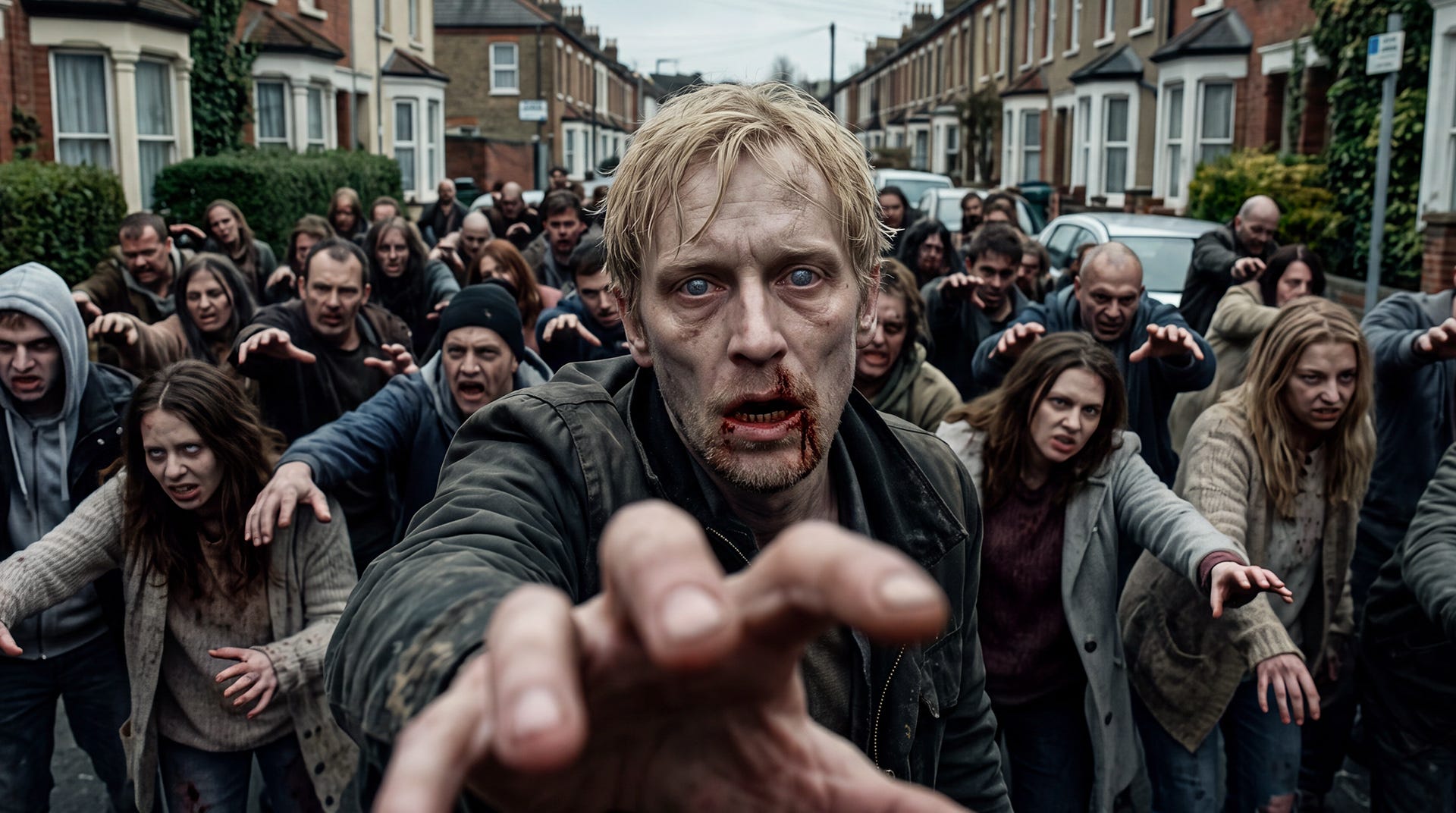
We have been infected by a mind virus that has cost us our humanity. It has hollowed us out and made us undead. The virus is not self-interest, but the belief that the self is a sealed unit whose interests end at the skin. Like zombies, we have each become an extreme individual.
Let us first examine self-interest more closely. A person may act from self-interest without being selfish. They may feed a child, protect a friend, repair a community or care for someone who offers nothing in return. Yet all such actions are still motivated from within; there is nowhere else for motivation to occur.
I cannot be motivated by your motivation unless it becomes mine. A child’s hunger matters to me; a friend’s danger disturbs me; another person’s suffering becomes something I cannot leave unresolved. None of this makes the care false. It makes the care motivated.
Self-interest is therefore not the problem; it drives motivation. The mistake is placing self-interest inside a narrow picture of the self. That changes everything. Once that picture takes hold, the person is reduced to appetite and defence. The body still chooses, buys, works and competes, but something essential has stopped responding. The person is internally undead because what gives life meaning has been taken away.
The zombie metaphor is useful because human survival has always depended upon mutual care. We became human through bounded and grounded relationships within a shared field of mutual influence. Extreme individualism infects that inheritance. It hollows out the deep sense of belonging to something larger than ourselves until the pack to which we belong becomes nothing more than a mechanism leading each ravenous member towards the next opportunity to feed.
The Agreement We Never Quite Admit
We have been doing our best to fight the virus of isolated individualism.
We are uneasy when others announce that they act in their own interests because their interests may conflict with ours — itself a self-interested concern.
If you pursue money, influence, comfort or freedom, I may pay the price. Your self-interest may restrict my choices or make me part of your plan. So I would prefer it to focus on me. Unfortunately, you have your own centre of motivation.
Societies obscure this tension by placing a halo around sacrifice, generosity and service. The halo restrains us from openly preying on one another. In a civilisation infected by the narrow self, moral rules are barricades across the shopping centre: do not bite, trample or devour everything in sight. Resist becoming an obvious zombie.
But barricades do not cure the infection. A living community does not require its members to lack self-interest, but to be formed so that other lives matter. Yet if care matters only as a social construct designed to make the system work, the horde can be highly co-ordinated and even act with care without becoming a community. Its members follow the same signals and surge towards the same openings. Their unity is groupthink organising private hunger, constrained by a rule against openly eating one another.
That is why civilisation can look socially dense while feeling emotionally dead. Markets, platforms and institutions link us, but movement together is not life together. What kind of motivation travels through the links?
Extended Self-Interest
Care is not the opposite of self-interest. Care is self-interest extended beyond a narrow model of the self.
The usual argument confuses three things.
Self-interest is the basis of action.
Self-centred individualism interprets the self as isolated.
Selfishness advances narrowly understood interests at others’ cost.
The first is built into agency; the second interprets it; the third may follow.
The framework is decisive.
Extreme individualism is a perceptual cage installed in the mind: you are alone inside this body; everything beyond it is external; other people are resources, rivals, threats or scenery. Once this becomes habitual, relationships become transactions, attention becomes extraction, and belonging becomes a means of securing status or protection.
Morality must then command the self to resist itself: do not exploit the weak; do not ignore suffering. Such rules may be necessary, but they fight the framework within which they exist. Culture tells us we are separate competitors, then asks us to behave as though we are deeply interdependent. The appetite must police itself while the picture producing it remains untouched.
This does not mean that there are no individuals in our lives who matter to us purely for who they are. We are like zombies who, for a moment, seem to recover a little of their humanity when they draw close to those they love. That gives us hope. But it is too little to carry our humanity, fill the hollowness or make us truly human again.
The answer is not to abolish self-interest. It is to escape the perceptual cage.
The Enemy Is the Boundary
Imagine drawing a circle around a tree and declaring that everything important lies inside the bark. You would miss soil, rain, fungi, sunlight, atmosphere and forest. The tree is distinct, but not independent. Its boundary gives it form without cutting it off from the causal flow sustaining it.
The human self is similar. You are a distinct experiential and operative centre — what I call, in my book Flowmonics, an epicentre of causal influence — with your own memories, sensations, decisions and history. But none of these developed alone. Language came through participation; identity through relationships; expectations through a world organised by others.
The self is real, but deeply relational: not a sealed object occasionally interacting with its environment, but a living structure formed through interaction. To be alive is to possess a boundary through which the causal flow of the shared field of influence can pass without the self losing its coherence.
The zombie self mistakes the body for the whole person. Its boundary has ceased to be a porous membrane and has become a wall. It registers danger, pleasure, pain and advantage, but not participation. It feels the world resisting it rather than constituting it.
Breaking down those walls does not mean destroying plurality. Other people are part of the structure in which you exist. Their behaviour affects your possibilities; their stability affects the systems upon which you rely. Yet removing the walls does not make them pieces of a hive mind. They remain distinct centres with perspectives you cannot fully enter and purposes you cannot control. Plurality is produced within integration, not erased by it.
A society is integrated when distinct agents participate in a common structure without being destroyed by it, not when everyone becomes the same. The cure cannot be a collective mind. Zombies already exhibit collective motion. It is ugly and, quite frankly, very scary. Conformity is not community.
A narrow model of agency certainly has evolutionary use: creatures must recognise danger and defend their bodies. But a framework evolved for emergency survival becomes disastrous when adopted as a civilisation’s philosophy. Again, the enemy is not the self. It is the false boundary around it.
Draw that boundary too tightly and fragmentation follows. The individual protects immediate advantage while weakening the structures upon which it depends. Trust erodes, relationships become transactional, and institutions become predatory. The narrow self appears to win while the shared field deteriorates, then inherits the deterioration.
The Horde Is Not a Community
The infected individual is not alone. They may be surrounded by millions moving in the same direction. Zombies move in packs.
The horde has information. We share tips, contacts, strategies and market signals; we call it networking, optimisation, growth or opportunity. Often, it is useful. It is what builds our great civilisation. But under the narrow framework, co-operation remains subordinate to appetite: I help because your movement may help mine.
The horde also has groupthink. A society can pursue more wealth, status, visibility, consumption and speed without asking what any of it is meant to satisfy. The crowd supplies direction while appetite supplies propulsion.
That appetite cannot be satisfied by what it consumes. Relational deprivation becomes acquisition: insecurity seeks control; insignificance seeks status; disconnection seeks attention; mortality seeks accumulation. Each mouthful promises life but leaves the deadness untouched.
So “more” becomes permanent. The zombie does not eat to become nourished and stop; it eats because eating is all that remains of purpose. When success loses any relation to enough, growth becomes movement without arrival.
Such a civilisation may be technologically brilliant and spiritually lifeless. It connects everyone while turning connection into leverage, and celebrates individuality while producing standardised appetites. We continue to care, but against the grain of its picture of us.
What the Better Framework Makes Us Do
A framework does not merely tell us what the world is. It determines what can matter to us.
If I understand myself as separate, another’s suffering appears outside me. It matters when it threatens, inconveniences or disturbs me. Helping remains conditional: I help while the suffering affects me. Once the effect weakens, so does the motivation.
We often call this human nature. It may be bad cartography.
A wider framework changes how motivation forms. If I understand myself as participating in a larger causal field, another person’s condition is not merely an event elsewhere. Fear alters behaviour; behaviour alters relationships; relationships alter homes, communities and institutions. Suffering travels as mistrust, aggression, withdrawal or despair.
Once I understand that lives are causally integrated, the condition of others can become part of my self-interest without first becoming a reward or threat. The framework decides what the self can be moved by.
A narrow framework says: “This matters because it is happening to me.”
A relational framework says: “This matters because it is happening within the reality of which I am a part.”
The motivation still occurs within me; it could not occur elsewhere. But it is no longer confined to protecting an isolated individual. I need not wait for another person to reward me or prove useful. Their condition matters within the structure through which I understand my existence.
Helping may make me feel better or bring the world closer to a form I can live with. That does not corrupt the action. The question is not whether I gain internally — of course I do, or I would not act — but what my system registers: only personal gain and loss, or the wider conditions from which its life emerges?
Self-interest can contract into self-centredness or expand into integration. Another’s suffering must reach my awareness before motivating me. But once it does, I need not pretend to act from outside myself. I act because what happens to them is part of the reality that matters to me.
That is not the defeat of self-interest. It is self-interest operating within a wider, more inclusive framework. This is the basis of how I approached unconditional love in my book Flowmonics.
The Framework Becomes the Motive
We imagine motivation arriving first and morality afterwards to control it. Ethics stands beside appetite like a nervous supervisor: the handler keeping a ravenous creature on a short chain.
The framework, however, sits further upstream. It determines what the self wants, notices and experiences as requiring action. It redraws the boundary between “my condition” and “something happening elsewhere”. Change that boundary, and you change what can motivate the person.
This is why demanding selflessness is unstable. The individual is asked to act against a self-centred picture while leaving it intact: taught that others are separate, that interests compete and that life is private, then told to behave as though none of this were true.
The better framework does not command the self to abandon itself. It removes that tension. It lets the self recognise more of the reality from which it is formed. Another person’s suffering must acquire meaning within your experience before it can move you. That is how motivation works. The question is what it means when it arrives: merely an inconvenience or threat, or also a disturbance within the causal field in which your life takes shape?
The event is the same. An expanded framework changes its meaning, and meaning changes action.
A relational framework does not produce kindness every time. It gives concern a more stable foundation by making what happens beyond the body intelligible as part of the self’s own reality.
Coming Back to Life
The cure is not the destruction of individualism. Destroy the individual, and you may create a more obedient horde. A living society needs distinct centres of judgement, creativity and responsibility: people capable of saying “I”, not creatures dissolved into collective command.
What must be destroyed is the fantasy that individuality means isolation.
We need an individualism alive to its conditions: one that understands autonomy as something developed through relationships, freedom as something sustained by trust, and flourishing as participation in a world that allows others to flourish too. The individual remains a centre, but no longer mistakes being a centre for being the whole field.
Self-interest has never had a fixed size. It can contract around comfort, status and survival, becoming zombie hunger: repetitive and incapable of enough. Or it can extend through family, friendship, community, civilisation and the living systems upon which they all depend.
The motivational centre remains within the acting person. What changes is the reality that centre has learned to include.
To come back to life is not to become selfless, but responsive: to feel the causal and moral texture of the world rather than collide with it; to recognise others not as food, tools, threats or spectators, but as distinct centres whose possibilities are entangled with our own.
Understand the self as a centre within an integrated causal flow, and others’ suffering, stability and possibilities appear not as commands from a manufactured moral realm, but as features of the reality from which your motives arise.
The zombie in us is not cured by starving the self, nor by killing it. It is cured by teaching the self what it is alive within.
You do not need to leave the self behind.
You need to discover where it actually ends.